






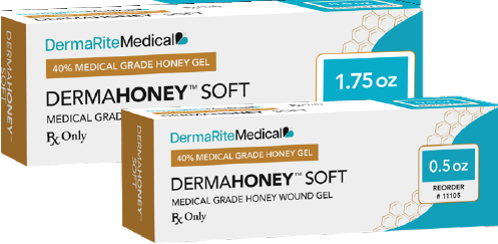
DermaHoney™ Soft
Wound gel with 40% medical grade honey, enhanced with Medilan™ hypoallergenic medical grade lanolin, vitamins C&E, PEG 4000, and propylene glycol

DermaRite Medical
Our mission is to deliver wound care and nutrition products that support quality care and better outcomes. Through practical education and support, we empower those who provide and receive care.
Benefits
Enhancements make it more effective than non-supplemented honey. Faster healing compared to honey alone. Vitamins C&E provide anti-inflammatory benefits, support collagen synthesis, tensile strength, and epithelial cell migration. The 40% MGH formula addresses concerns of cytotoxicity and pain associated with other honey products. Low pH inhibits bacterial growth.
Indications
Partial- and full thickness wounds, including diabetic foot ulcers, arterial, venous, and mixed etiology ulcers of the lower extremity, pressure injuries, partial-and full-thickness, first and second degree partial-thickness burns, donor sites, traumatic wounds, and surgical wounds.
Contraindications
Third-degree burns, patients with a known sensitivity to honey or any other component parts, dirty, infected, and heavily exudating wounds, deep, narrow cavities.
Warnings and Precautions
Due to the low pH, some patients may notice slight, transient stinging upon application. If stinging persists, and cannot be managed with an analgesic, remove the dressing, cleanse area, and discontinue use. During initial use, the dressing's high osmolarity may contribute to increased exudate. Due to its autolytic debridement properties, non-viable tissue is commonly removed, resulting in an initial increase in wound size. Consult a healthcare professional if signs of infection are noted. Do not use the product if the immediate product packaging is damaged.
Storage Requirements
Store at room temperature between 41–77°F. Avoid direct sunlight and moisture. See IFU for additional information.
How Supplied/Sizing
0.5 oz tube, 1.75 oz. tube
HCPCS Code
Product features
Adhesive border
Alginate dressing format
Amorphous hydrogel dressing format
Compatible w/ topicals
Cuttable
Flexible
Foam dressing format
Gauze or non-woven dressing format
Intact when saturated
Moisture vapor permeable
One-piece removal
Secondary dressing required
Self-adhering
Usable on infected wounds
Variety of sizes
Other features
Educational Material Available
Free Samples/Trials Available
Published Clinical Article Available
Recommended Use
Acute Wounds
Burns
Chronic Wounds
Dehisced Wounds
Diabetic Foot
Granulating/Epithelializing Wounds
Non/Minimally Exudating Wounds
Palliative Wounds
Pressure Ulcers
Sloughy Wounds
Superficial Wounds
Surgical Wounds
Venous Ulcers
Mode of Use/Application
Topical wound gel
Removal & Change Frequency
Dressing change frequency will depend on the wound condition and level of exudate. Reapply when the gel is no longer visible, or as directed by a wound care professional.
Additional Recommended Dressings
Secondary dressing is required
Clinically Tested
Non-cytotoxic
No posters match your selected filters. Remove some filtres, or reset them and start again.
Related Products

UrgoTul™ AgUrgo Medical North America

Cutimed® EpionaEssity

Vashe® Antimicrobial Wound GelUrgo Medical North America

UrgoClean AgUrgo Medical North America


Have a product to submit?
Be included in the most comprehensive wound care products directory
and online database.
Learn More