






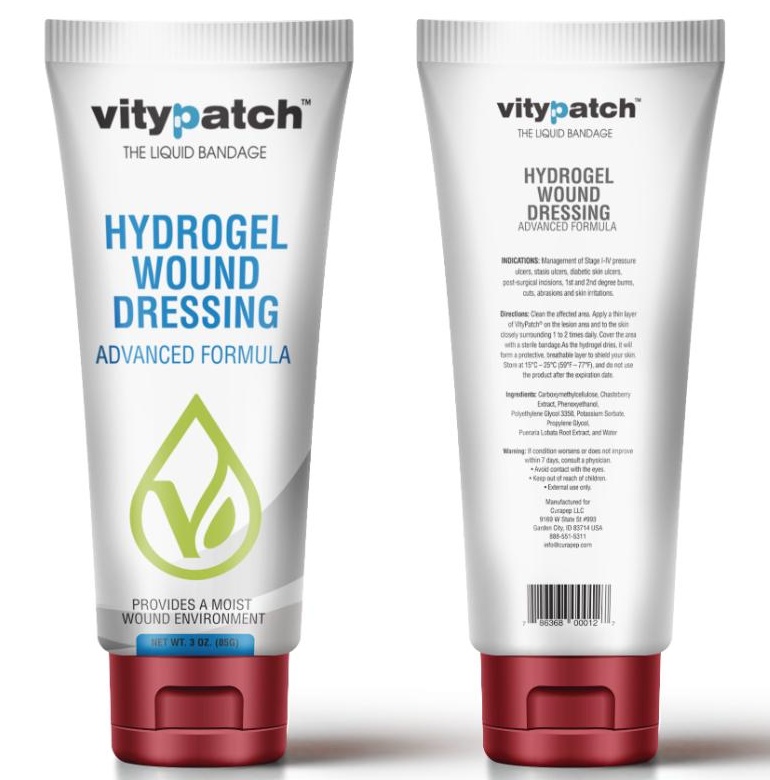
VityPatch™ Hydrogel
VityPatch™ Hydrogel is an amorphous hydrogel wound dressing that maintains a moist wound environment, supports autolytic debridement, and provides an oxygen-supportive environment.
Curapep
Curapep is a biotechnology company focused on wound care and skin health. The company develops science-driven products such as VityPatch Hydrogel and Vitynex Cream, designed to support a moist, oxygen-friendly healing environment for everyday skin injuries and select chronic wounds under clinician guidance.
Toll free:
(888) 551-5311
Website: https://curapep.com
Benefits
Maintains moisture balance and helps prevent wound bed desiccation; supports autolytic debridement of slough and non-viable tissue; oxygen-permeable, non-occlusive interface (Oxygen Boost Technology™); soothing, cooling effect; conforms to irregular and cavity wound beds; easy application and atraumatic removal; compatible with topical antimicrobials (e.g., silver, PHMB); antibiotic-free, fragrance-free, dyefree, paraben-free.
Indications
Management of partial- and full-thickness wounds, including but not limited to pressure injuries/ulcers (Stages 2–4), diabetic foot ulcers, venous leg ulcers, first- and second-degree burns, donor sites, surgical and post-procedural wounds (e.g., post-Mohs, post-laser) healing by secondary intention, abrasions, and traumatic wounds.
Contraindications
Third-degree burns; known hypersensitivity to any hydrogel component; wounds with established clinical signs of infection without concomitant appropriate antimicrobial therapy.
Warnings and Precautions
For external use only. Discontinue use if irritation occurs. Apply gel to the wound bed only, not the surrounding skin; if peri-wound maceration occurs, reassess exudate and consider a more absorptive secondary dressing or barrier film. Monitor for signs of infection and initiate appropriate antimicrobial therapy if suspected. If no improvement after 2–4 weeks of consistent care, re-evaluate the overall treatment plan (offloading, compression, vascular status, nutrition). Single-patient, multiple-use tube; avoid tip contact; recap tightly after each use.
Adverse Effects/Reactions
No device-related adverse events, allergic reactions, or irritation were reported in the post-Mohs secondary-intention case series (n=21). Discontinue use if irritation or sensitivity occurs.1
Reference
1. Khachemoune A, Shimp L, Selim H. Revolutionizing recovery: VityPatch's breakthrough in accelerating healing post–Mohs micrographic surgery for secondary intention wounds. White paper available at https://drive.google.com/file/d/1o7GSHm6hXvQEdisPqptWGnTinNzZubLu/view.
Storage Requirements
Store at room temperature, 15–25°C (59–77°F). Keep tube tightly capped when not in use. Do not use after the expiration date.
Inactive Ingredients
Carboxymethylcellulose, chasteberry extract, phenoxyethanol, polyethylene glycol 3350, potassium sorbate, propylene glycol, Pueraria lobata root extract, water.
How Supplied/Sizing
Amorphous hydrogel. Tube: 3 oz (single-patient, multiple-use).
HCPCS Code
Product features
Antimicrobial format available
Clear
Compatible w/ topicals
Conforms readily to wound
Limited shelf life
Moisture vapor permeable
Powder form
Preserved multiple dose
Secondary dressing required
Unpreserved unit dose
Usable on infected wounds
Other features
Educational Material Available
Free Samples/Trials Available
Published Clinical Article Available
Recommended Use
Acute Wounds
Burns
Cavity Wounds
Chronic Wounds
Deep Wounds
Dehisced Wounds
Diabetic Foot
Granulating/Epithelializing Wounds
Non/Minimally Exudating Wounds
Pressure Ulcers
Sloughy Wounds
Superficial Wounds
Surgical Wounds
Venous Ulcers
Mode of Use/Application
Cleanse/irrigate wound with sterile saline and pat peri-wound skin dry. Shallow (granulating/epithelializing) wounds: apply an even layer (~5 mm) to the wound bed, extending slightly beyond the margins; cover with a non-adherent silicone contact layer or foam. Deep wounds with cavities, tunneling, or undermining: impregnate sterile gauze or alginate rope with gel and loosely pack to contact all surfaces; cover with an absorptive secondary dressing. Necrotic eschar/slough (autolytic debridement): apply a thick layer directly to non-viable tissue (cross-hatch stable, non-infected eschar if needed); cover with an occlusive or semi-occlusive dressing (transparent film or hydrocolloid).
Removal & Change Frequency
Change every 24–72 hours, or when strike-through of the secondary dressing occurs; more frequent changes may be needed during active debridement. At each change, gently irrigate to remove residual gel and liquefied slough, reassess the wound, and reapply.
Additional Recommended Dressings
Foam dressings; non-adherent silicone contact layers; alginate rope or sterile gauze (as packing carrier); transparent film or hydrocolloid (for autolytic debridement); compression therapy for venous leg ulcers. May be used with topical antimicrobial dressings (e.g., silver, PHMB).
Construction
Amorphous, oxygen-permeable hydrogel matrix supplied in a 3 oz tube. Antibiotic-free; fragrance-, dye-, and paraben-free.
Warranty
Curapep 100% Satisfaction Guarantee on all direct orders; contact Customer Service for returns or resolution.
Clinically Tested
Non-cytotoxic
Non-irritating
Non-sensitizing (ISO 10993-10)
Technical Specifications
Biocompatibility tested per ISO 10993-5 (cytotoxicity), ISO 10993-10 (sensitization), and ISO 10993-23 (irritation). US FDA Class I, 510(k)-exempt hydrogel wound dressing; registered and listed with FDA.
No posters match your selected filters. Remove some filtres, or reset them and start again.
Related Products

Drawtex®Urgo Medical North America

UrgoClean AgUrgo Medical North America

Cutimed® EpionaEssity

UrgoTul™ AgUrgo Medical North America


Have a product to submit?
Be included in the most comprehensive wound care products directory
and online database.
Learn More